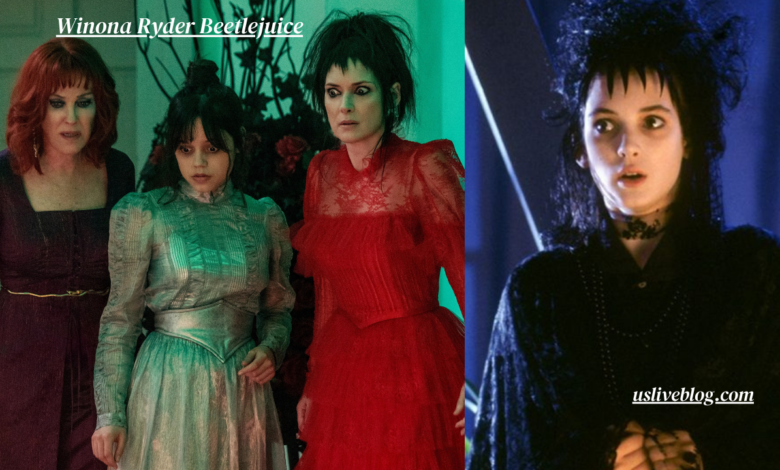
Winona Ryder Beetlejuice There are certain performances in cinema history that feel genuinely transformative not just for the film itself, but for the career of the actor delivering them. Winona Ryder Beetlejuice is exactly that kind of story. When Tim Burton’s wildly imaginative supernatural comedy hit theaters in 1988, nobody could have fully predicted that a sixteen-year-old actress playing a goth-obsessed teenager would become one of the most talked-about performances of the entire decade. Yet that’s precisely what happened, and the ripple effects of that singular role shaped everything that came after in one of Hollywood’s most fascinating careers.
How Winona Ryder Landed the Role of Lydia Deetz
The casting story behind Winona Ryder Beetlejuice is one of those Hollywood moments that feels almost fated in retrospect. Tim Burton was already developing a reputation as a director with a genuinely singular visual imagination, coming off the success of Pee-wee’s Big Adventure. For Beetlejuice, he needed someone to play Lydia Deetz — a deeply unusual teenage girl, obsessed with death and the macabre, who sees the world in a way that nobody around her quite understands. Finding the right actress for that role was absolutely critical.
Winona Ryder, still a relative newcomer at the time, had appeared in Lucas and Square Dance, but nothing that had put her firmly on Hollywood’s radar. What she brought to the Winona Ryder Beetlejuice audition was something that couldn’t be manufactured or taught — an authentic quality of otherness, a genuine depth behind the eyes that made you believe completely that this was a girl who actually preferred the company of ghosts to the company of her peers. Burton recognized it immediately, and the casting decision was made.
What makes the Winona Ryder Beetlejuice origin story so compelling is how perfectly matched actress and role turned out to be. Ryder has spoken in interviews about feeling a deep personal connection to Lydia — the sense of not quite belonging, of seeing things differently than everyone around you. That wasn’t just acting. It was a young woman finding a character who reflected something real about her own inner life, and that authenticity absolutely translates on screen in ways that are almost impossible to fake.
The Character of Lydia Deetz and What Made Her Special

To fully appreciate Winona Ryder Beetlejuice, you have to understand just how unusual Lydia Deetz was as a character in the context of 1988 cinema. Hollywood’s teenage girls at that moment were largely being written as cheerleaders, love interests, or comedic sidekicks. Lydia was none of those things. She was cerebral, melancholic, genuinely strange, and completely uninterested in conforming to anyone’s expectations of what a teenage girl should be.
The genius of Winona Ryder Beetlejuice as a performance is how Ryder balanced Lydia’s darkness with an underlying warmth and vulnerability. Lydia could have easily tipped into parody — the gloomy teen as joke. Instead, Ryder played her as someone with real emotional depth, a kid who was genuinely lonely and genuinely searching for connection in a world that felt alien to her. When she finally finds that connection with the ghostly Maitlands, it lands with real emotional weight because Ryder has done the work of making you care about this girl.
The aesthetic of Lydia Deetz, crafted through the collaboration between Ryder’s performance and the film’s extraordinary costume and production design, became immediately iconic. The all-black wardrobe, the camera perpetually hanging around her neck, the particular way she carried herself through the garish chaos of the Deetz household — all of it coalesced into a character who felt genuinely new. Winona Ryder Beetlejuice didn’t just give audiences a memorable performance; it gave them a genuine cultural archetype that still resonates today.
Tim Burton and Winona Ryder A Creative Partnership Born on Set
The making of Winona Ryder Beetlejuice was the beginning of something that extended well beyond a single film. The creative chemistry between Ryder and Burton on set was immediately apparent to everyone involved in the production. Burton found in Ryder an actress who instinctively understood his aesthetic sensibility — the darkness laced with whimsy, the emotional sincerity operating beneath layers of the bizarre and fantastical.
For Ryder, working with Burton was a revelation about what filmmaking could be at its most imaginative. The world of Winona Ryder Beetlejuice — that gloriously strange, handcrafted universe of practical effects and expressionist set design — was unlike anything she had encountered in her brief career to that point. Being at the center of it, playing the character whose perspective essentially anchors the audience in all that weirdness, was a formative artistic experience that clearly influenced her subsequent instincts as an actress.
The Burton-Ryder partnership extended to Edward Scissorhands in 1990, but its foundations were laid entirely on the set of Beetlejuice. That film established a creative trust between director and actress that allowed both of them to take risks and push further than they might have with collaborators they knew less intuitively. The Winona Ryder Beetlejuice experience was, in a very real sense, the birthplace of one of cinema’s most celebrated creative relationships.
The Cultural Impact of Winona Ryder Beetlejuice
It’s genuinely difficult to overstate how culturally significant Winona Ryder Beetlejuice turned out to be in the long run. In 1988, the film was a solid commercial and critical success, but nobody was necessarily predicting that it would achieve the kind of enduring cult status it now holds. Decades later, it remains one of the most beloved films of its era, and Lydia Deetz has become something close to a cultural institution.
The character that Winona Ryder brought to life in Beetlejuice became a touchstone for generations of young people who felt like outsiders. The goth aesthetic, the unapologetic strangeness, the refusal to pretend to be something she wasn’t — Lydia resonated deeply with viewers who didn’t see themselves represented in more conventional teen characters. Winona Ryder Beetlejuice essentially helped create a template for a certain kind of cinematic outsider that filmmakers have been drawing on ever since.
Beyond the cultural influence, the film’s impact on Ryder’s own career trajectory cannot be overstated. Winona Ryder Beetlejuice was the movie that made Hollywood take her seriously as a talent worth investing in. The roles that followed — Heathers, Edward Scissorhands, Mermaids, Bram Stoker’s Dracula, The Age of Innocence — were all made possible because Beetlejuice demonstrated definitively that this young actress had genuine star power combined with real artistic depth.
Beetlejuice Beetlejuice Ryder Returns Decades Later
The story of Winona Ryder Beetlejuice took a remarkable new chapter when Tim Burton’s long-awaited sequel, Beetlejuice Beetlejuice, arrived in 2024. The idea of returning to Lydia Deetz after more than three decades was something Ryder approached with both excitement and genuine care. Getting back inside a character that meant so much to her personally and professionally was never going to be a casual undertaking.
What made the Winona Ryder Beetlejuice sequel particularly fascinating was the creative decision to show Lydia as an adult — a woman carrying the weight of everything that happened to her as a teenager, still marked by those experiences in ways both visible and invisible. Ryder brought the same emotional honesty to the older Lydia that she had brought to the younger version, finding the through line between who this character was at sixteen and who she had become decades later.
The reception to Winona Ryder Beetlejuice’s return was overwhelmingly positive from fans who had grown up with the original. Seeing Ryder step back into that role felt like a genuine homecoming — for the character, for the actress, and for audiences who had carried Lydia Deetz with them through their own lives. The sequel proved that the connection between this actress and this character was something durable and real, not just a nostalgic illusion.
What Winona Ryder Beetlejuice Means for Her Overall Legacy
Step back and look at the full arc of Winona Ryder’s career, and Beetlejuice stands as one of its foundational pillars. Without Winona Ryder Beetlejuice, the extraordinary run of films she made in the late eighties and early nineties looks different — less inevitable, more contingent. Lydia Deetz was the role that established what kind of actress Ryder was going to be: someone drawn to complicated inner lives, to characters who exist slightly outside the mainstream, to performances that prioritize emotional truth over conventional likability.
The Winona Ryder Beetlejuice legacy also speaks to something broader about the relationship between actors and their signature roles. Some performances become so identified with an actor that they function almost as a second identity — a character who walks alongside the real person through their entire public life. Lydia Deetz is that for Ryder in a way that goes beyond typical pop culture association. There’s a genuine spiritual kinship between actress and character that audiences have always sensed and responded to.
In the end, Winona Ryder Beetlejuice endures because it captured something true about what it feels like to be young and strange and searching for connection in a world that doesn’t quite make sense. Ryder understood that truth at sixteen, delivered it with remarkable skill, and returned to it decades later with even deeper understanding. That’s not just a good performance in a beloved film — that’s a genuine piece of cinema history worth celebrating.
You May Also Read