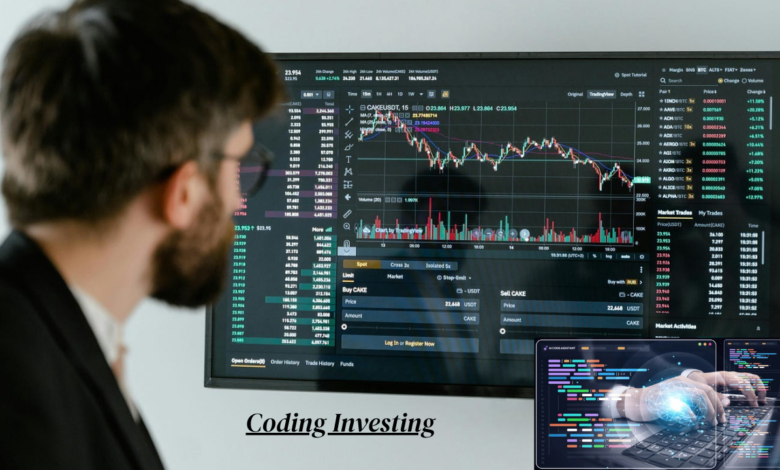
Coding Investing If you know how to code, you already have one of the most powerful advantages in the modern investing world. Most people overlook this. They treat coding as just a career skill and investing as something separate something they do with leftover money in a brokerage app on their phone. But when you bring these two worlds together, something genuinely exciting happens. Coding investing is not a gimmick or a niche hobby. It is a legitimate discipline that is reshaping how individuals and institutions approach financial markets. Whether you are a software engineer who has always been curious about markets, or a seasoned investor just starting to dabble in programming, the intersection of these two fields opens doors that simply do not exist for people who only know one side.
The idea is straightforward. You use programming skills to build tools, analyze data, automate decisions, and execute strategies in financial markets. But the execution is anything but simple. It takes real effort, a solid understanding of both domains, and the patience to build systems that actually work. This article breaks down exactly what coding investing is, why it matters, how to get started, and what separates people who do it well from those who end up frustrated and broke.
What Coding Investing Actually Means
Coding investing refers to the practice of using programming languages and software development techniques to participate in financial markets. This can take many forms. Some people write scripts to pull stock data and generate charts. Others build fully automated trading systems that open and close positions without any human involvement. Some use Python to backtest investment strategies over years of historical data before risking a single dollar. Others build portfolio optimization tools, sentiment analysis models, or custom dashboards that give them an edge in understanding what the market is doing.
What makes this approach powerful is that it removes the two biggest enemies of good investing — emotion and inefficiency. When a human investor watches a stock fall five percent in one afternoon, the temptation to panic-sell is enormous. A coded system does not panic. It follows the rules it was given. Similarly, when a human tries to monitor dozens of stocks across multiple sectors while keeping track of macroeconomic indicators, news events, and earnings releases, they inevitably miss things. A well-built program never sleeps and never loses focus.
It is also worth noting that coding investing is not exclusively about algorithmic trading. Some of the most practical applications are much simpler like automating your monthly contributions to an index fund, building a spreadsheet tool that tracks your net worth in real time, or writing a script that sends you an alert when a stock you are watching hits a particular price. Not every coder needs to build a hedge fund. Even modest automation can meaningfully improve your results over time.
Why Programmers Have a Natural Edge in Investing

Coding Investing Programmers think in systems. They are trained to break complex problems into smaller components, identify dependencies, test assumptions, and iterate toward better solutions. This mindset maps almost perfectly onto smart investing. Good investing is about building a system a repeatable process for evaluating assets, managing risk, sizing positions, and reviewing results. Most retail investors never develop that kind of discipline. They rely on gut feeling, follow tips from friends, or react emotionally to headlines. A programmer building an investment system naturally tends to be more structured.
Data literacy is another major advantage. Financial markets produce enormous amounts of data every single day — price feeds, volume data, earnings reports, economic releases, options flow, news sentiment, and much more.
Coding Investing There is also the matter of cost. Professional money managers charge steep fees to access sophisticated investment strategies. A programmer can build many of those same strategies themselves for almost nothing. The tools available today Python with libraries like pandas, NumPy, and backtrader; free data APIs from providers like Yahoo Finance or Alpha Vantage; cloud computing platforms that run code for pennies per hour — have democratized access to quantitative investing in a way that was unimaginable twenty years ago. The barrier to entry has never been lower.
Popular Programming Languages for Investing
Python is the undisputed king of coding investing. Its combination of simplicity, readability, and an incredibly rich ecosystem of financial libraries makes it the first choice for the vast majority of quantitative traders, analysts, and individual investors who code. Libraries like pandas handle data manipulation, NumPy handles numerical computation, matplotlib and plotly handle visualization, and specialized tools like zipline, backtrader, and quantconnect provide full backtesting frameworks. If you are new to coding investing and wondering where to start, Python is the answer.
R is another strong contender, particularly for people coming from a statistics or academic background. It has deep libraries for financial analysis and time series modeling, and many professional researchers in finance still use it.
For lower-level performance needs — particularly in high-frequency trading where latency is measured in microseconds — C++ remains the language of choice among professional firms. But this is a specialized domain that requires advanced software engineering skills and is largely out of reach for individual investors. JavaScript has also carved out a niche in the space, particularly for people building web-based investing dashboards and tools. The good news is that regardless of which language you use, the underlying concepts of coding investing remain the same.
Getting Started with Algorithmic Investing
Coding Investing The first step is to stop thinking about investing and coding as separate pursuits. Start building projects that combine both. A great beginner project is pulling historical stock data for a handful of companies, calculating simple moving averages, and plotting them on a chart. It sounds basic, but the process of doing this teaches you how to work with financial data, how to think about price trends, and how to present information visually. From there, you can layer on more complexity — adding indicators, testing simple rules, calculating returns.
Backtesting is where things get really interesting. A backtest lets you apply an investment strategy to historical data to see how it would have performed. For example, you might test a rule like: buy a stock when its 50-day moving average crosses above its 200-day moving average, and sell when the reverse happens.
Once you have a strategy that looks promising in backtesting, paper trading is the next step. This means running your strategy in a simulated environment using real market data but fake money. Most brokerages and trading platforms offer paper trading accounts. It is a critical step because real markets behave differently from historical data in subtle but important ways — slippage, bid-ask spreads, news events that create unusual volatility. Getting your system to work well in paper trading before going live will save you a lot of money and heartache.
Risk Management The Part Most People Skip
Here is an uncomfortable truth about coding investing a strategy that looks great in backtesting can blow up spectacularly in real markets if it is not built with proper risk controls. This is where many beginners come unstuck. They get excited about a strategy that shows impressive returns in historical data, rush to deploy it with real money, and then discover all the ways it can go wrong. Building good risk management into your system from the start is not optional — it is the most important thing you can do.
Position sizing is the foundation. No single position in your portfolio should be large enough that a bad outcome in that one trade damages your overall financial situation. Many systematic traders use rules like never risking more than one or two percent of total capital on a single trade. Coding Investing This sounds conservative, and it is — intentionally so.
Building a Data-Driven Investment Portfolio
One of the most practical applications of coding investing for the average person is portfolio construction. Rather than picking stocks based on gut feel or surface-level research, you can use data to build a portfolio that is systematically diversified and optimized for your specific goals and risk tolerance. This is not as complicated as it sounds. Modern portfolio theory, developed by Harry Markowitz decades ago, provides a mathematical framework for balancing expected returns against risk. And with Python, implementing a basic version of this optimization is a weekend project.
Factor investing is another powerful approach that becomes accessible through coding. The idea is to build a portfolio that systematically tilts toward stocks with characteristics that have historically been associated with above-average returns — things like low valuation multiples, strong earnings momentum, or low volatility.
What is particularly valuable about this approach is the transparency it creates. When you build your own portfolio system, you understand exactly why every holding is in the portfolio and exactly what conditions would cause it to be removed.
Common Mistakes to Avoid in Coding Investing
Overfitting is probably the most common and damaging mistake in quantitative investing. It happens when you optimize your strategy too heavily on historical data, tuning every parameter until the backtest results look spectacular. The problem is that a strategy optimized this way has essentially memorized the past rather than discovered a genuine edge.
Ignoring transaction costs is another trap beginners fall into. Every time your strategy trades, you pay a spread and potentially a commission. For a strategy that trades frequently, these costs add up fast. A strategy that generates ten percent annual returns in a frictionless backtest might only produce four percent once realistic transaction costs are factored in. Always model trading costs explicitly and run sensitivity analyses to understand how much your strategy’s profitability depends on keeping costs low.
The Long Game Why Coding Investing Is Worth the Effort
Coding investing is not a get-rich-quick scheme. Anyone who promises otherwise is selling something. Building systems that consistently outperform the market is genuinely hard, and most strategies that seem promising in development do not survive contact with real markets. But here is the thing — even if you never build a trading strategy that beats the index, the skills and habits you develop through coding investing will make you a far better investor overall. You will understand data more deeply, think more rigorously about risk, and make decisions based on evidence rather than emotion.
The compounding effect over time is where this really pays off. Investors who build disciplined, data-driven systems and stick with them through market cycles tend to outperform those who react emotionally over the long run. Add to that the cost savings from managing your own portfolio rather than paying active management fees, and the numbers start to look very compelling. Over a twenty or thirty-year investing career, those savings and improvements in decision-making quality can translate into hundreds of thousands of dollars in additional wealth.
You May Also Read