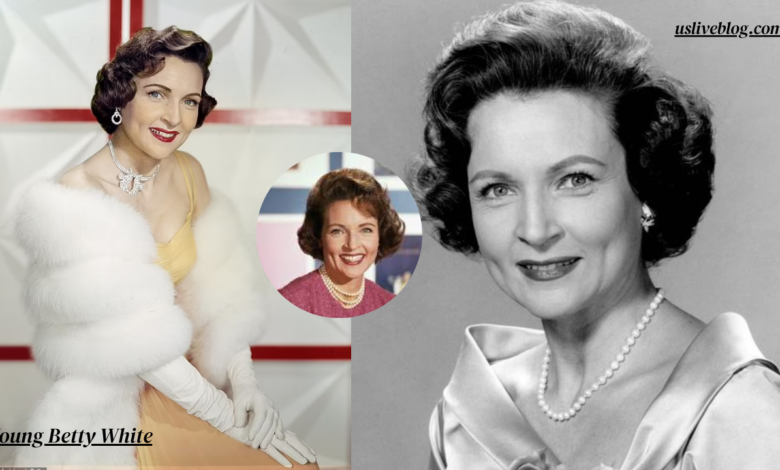
Young Betty White is one of the most beloved entertainers in American history, but most people only know her from her later iconic roles. What many don’t realize is that the sharp wit, the infectious charm, and that legendary work ethic? Those were there from the very beginning. Long before she was Rose Nylund or Eleanor Vance, there was a young Betty White a driven, passionate girl from Oak Park, Illinois, who had her eyes set firmly on the spotlight. Let’s take a deep dive into the early years of this remarkable woman and understand how the foundation of a legend was quietly being built.
Early Childhood and Family Background
Young Betty White was born on January 17, 1922, in Oak Park, Illinois, to Horace Logan White and Christine Tess. She was an only child, and by all accounts, her parents were her biggest cheerleaders. Her father worked in the lighting equipment industry and her mother was a homemaker, and together they created a warm, stable household that gave young Betty the confidence she would carry throughout her entire life.
The family moved to Los Angeles when Betty was still very young, settling in the city that would eventually become the backdrop for her entire career. Growing up in LA during the 1920s and 30s was a unique experience — the entertainment industry was blooming all around, and for a naturally curious and expressive child like Betty, the energy of that city was impossible to ignore. She soaked it all in like a sponge.
What’s particularly interesting about Betty’s childhood is how grounded she remained despite growing up so close to Hollywood glamour. Her parents emphasized values, kindness, and hard work over fame-chasing. Those lessons never left her. Friends and colleagues who worked with Young Betty White decades later often noted that she had an almost old-fashioned sense of graciousness — and that came directly from how she was raised.
School Years and Discovering a Passion for Performance

Young Betty White attended Beverly Hills High School, which yes is as glamorous as it sounds. But even in that star-studded environment, Betty stood out. She was deeply involved in school theater and discovered early on that performing wasn’t just something she enjoyed; it was something she needed. There’s a big difference between a kid who likes being on stage and one who is genuinely called to it, and Betty was absolutely the latter.
During her school years, she also developed a love for writing. She contributed to school publications and showed a natural ability to string words together in ways that were both funny and thoughtful. That combination of performance and writing sensibility would later make her one of the sharpest comedic minds on television — someone who didn’t just deliver lines but truly understood them.
She graduated from Beverly Hills High School in 1939 with a clear sense of purpose. While many of her peers were uncertain about the future, Betty had a plan. She wanted to be in entertainment, full stop. The confidence she carried wasn’t arrogance — it was clarity. She knew what she was meant to do, and she was ready to go do it.
The Struggle to Break Into Show Business
Here’s where the story gets real. Breaking into entertainment as a young woman in the late 1930s and early 1940s was anything but easy. The industry had very specific ideas about what women could and couldn’t do, and young Betty White ran into those walls more than once. She auditioned, got rejected, auditioned again, and kept going. That resilience became one of her most defining traits.
Her early attempts to get work in Hollywood were met with a fair amount of resistance. She was told at one point that she wasn’t “photogenic enough” for television — which, looking back, is one of the most absurd things anyone has ever said about anyone. But Betty didn’t crumble under that kind of dismissal. Instead, she pivoted, adapted, and found other ways in.
Young Betty White began doing work in radio, which at the time was still a dominant entertainment medium. Radio suited her perfectly — her voice was warm, expressive, and had a natural comedic timing that translated beautifully through the airwaves. This period of her career is often overlooked, but it was critically important. Radio taught her discipline, taught her how to carry an audience without visual aids, and sharpened her instincts in ways that would serve her for the next seven decades.
Young Betty White and the Dawn of Television
When television began to emerge as the next big thing in entertainment, Betty White was ready. She jumped into the new medium early and with both feet. In the late 1940s, she began appearing on local Los Angeles television, doing anything and everything — variety shows, commercials, guest spots. She was building a reputation as someone who was reliable, talented, and incredibly easy to work with.
By 1949, she had become a regular on a local TV show called Hollywood on Television, a live show that aired six days a week. Six. Days. A week. Live television. That is an absolutely brutal schedule, and Betty handled it with what colleagues described as effortless professionalism. In reality, there was nothing effortless about it — it required enormous preparation and stamina, but Betty made it look natural.
This early television work gave her something invaluable: experience. While other performers were waiting for the “right” opportunity, Young Betty White was out there grinding, making mistakes on live TV, learning in real time, and building an audience. By the early 1950s, she wasn’t just a hopeful young actress anymore — she was a known quantity, and people in the industry were paying attention.
Love for Animals A Lifelong Passion That Started Young
One thing that defined young Betty White just as much as her love for performing was her extraordinary connection to animals. From a very early age, Betty was passionate about animals in a way that went beyond having a pet or two. She genuinely cared about their welfare, their treatment, and their place in the world.
Her parents supported this passion, and growing up, the White household was always home to various animals. Betty has spoken in interviews about how animals gave her a sense of unconditional connection that she treasured deeply. There was no pretense with animals, no politics, no hidden agenda — just pure, honest companionship. For a young girl growing up in a world that could be complicated and demanding, that simplicity meant everything.
This love never faded. Throughout her career, Young Betty White used her platform to advocate for animal rights and welfare, working closely with the Los Angeles Zoo and various animal organizations. But it all started when she was just a kid in a family home with a menagerie of beloved pets. The little girl who loved animals grew into one of their most prominent and dedicated public champions.
The Making of a Comedy Genius
People tend to think of comedic talent as something you’re either born with or you’re not. The truth is more nuanced, and Young Betty White early life illustrates that beautifully. Yes, she had a natural wit — her timing was instinctive, and her ability to find the funny in everyday moments was genuine. But she also worked incredibly hard to develop and refine that talent.
In her early television years, Betty studied comedy the way a musician studies scales. She watched other performers, analyzed what worked and what didn’t, and constantly pushed herself to be sharper, smarter, and more precise. She understood that great comedy isn’t about being loud or silly — it’s about truth, timing, and the willingness to be completely present in the moment.
What set young Young Betty White apart from many of her contemporaries was her ability to be funny without being mean. Comedy in the mid-20th century often relied on put-downs and stereotypes, but Betty gravitated toward a warmer, more humanistic style of humor. She could get a laugh by simply reacting authentically to something absurd. That quality — finding comedy in truth rather than cruelty — is what made her universally beloved across generations.
A Young Woman Ahead of Her Time
Looking back at young Betty White’s early career, what’s striking is how far ahead of her time she was. In an era when women in television were largely expected to be decorative or supportive, Betty was producing her own show. In the early 1950s, she co-founded Bandy Productions, making her one of the first women to produce a television program in the United States. She didn’t wait for someone to give her power — she went out and created it.
This entrepreneurial instinct was remarkable for the time. The entertainment industry in the 1950s was heavily male-dominated, and the idea of a woman taking creative and financial control of her own television production was genuinely groundbreaking. Betty did it not to make a statement, but because she saw an opportunity and had the vision and drive to pursue it. That’s just who she was.
Her early work also showed a remarkable lack of ego. Betty has always been known as someone who lifted up the people around her, who celebrated other performers rather than competing with them. That generosity of spirit wasn’t something she developed in her old age — it was baked into her character from the very start, shaped by her upbringing and her fundamental belief that there was enough room in the spotlight for everyone.
Conclusion
The story of young Betty White is ultimately a story about character. Talent matters, of course, and Betty had it in abundance. But what really drove her success — what kept her working and thriving for over eighty years in one of the most competitive industries on the planet — was the person she was at her core. Curious, kind, disciplined, funny, resilient, and deeply passionate about the things she loved.
She didn’t become a legend by accident. The groundwork was laid in an Oak Park hospital room in January 1922, nurtured in a loving family home, tested in countless auditions and live television broadcasts, and strengthened by every obstacle she faced and overcame. Young Betty White was already, in every way that mattered, exactly the person the world would one day celebrate. The world just hadn’t caught up to her yet.
You May Also Read