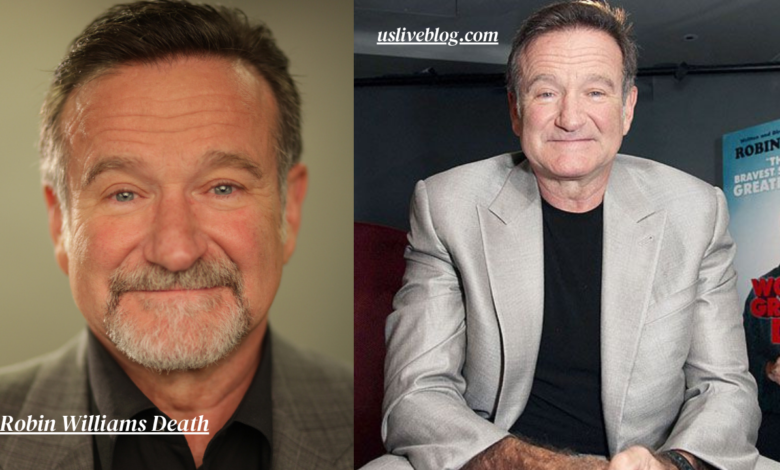
Robin Williams Death On August 11, 2014, the world received news that stopped people in their tracks. one of the most beloved entertainers in the history of Hollywood, had passed away at his home in Paradise Cay, California. Robin Williams death sent shockwaves through every corner of the globe. Fans wept openly. Fellow celebrities expressed disbelief. News anchors struggled to keep their composure. It was one of those rare moments where a celebrity’s passing felt deeply, personally devastating not just to those who knew him, but to millions of ordinary people who had grown up laughing with him, crying with him, and finding pieces of themselves in the characters he brought to life.
The Circumstances Surrounding Robin Williams Death
Robin Williams death was ruled a suicide by asphyxia. He was found unresponsive at his home by his personal assistant, who had grown concerned after he did not respond as usual that morning. He was 63 years old. The news was heartbreaking on its own, but what made Robin Williams death even more difficult to process was the public perception of the man. He was known for boundless energy, explosive humor, and an almost supernatural ability to make people feel joy. The idea that someone who radiated that much light could be suffering so deeply in private was something many people simply could not reconcile.
In the weeks following his passing, his wife Susan Schneider Williams shared details about what Robin had been going through in his final months. He had been experiencing severe depression, anxiety, and paranoia. There were also signs of cognitive decline that were troubling and confusing to those around him. At the time of Robin Williams death, many assumed his struggles were primarily related to depression or substance abuse — a narrative that felt incomplete and, as it turned out, was not the full picture.
It is important to approach the circumstances of Robin Williams death with sensitivity and accuracy, because the real story is more complex and more medically significant than most people realize. His death was not simply the result of a mental health crisis in the traditional sense. There was something else going on entirely, something that was only discovered after he was gone.
The Shocking Medical Discovery After His Passing

One of the most significant revelations to come out of Robin Williams death was the posthumous discovery that he had been suffering from Lewy body dementia — a particularly aggressive and cruel form of dementia that affects both cognitive function and physical movement. His wife Susan Schneider Williams wrote about this extensively and became a vocal advocate for greater awareness of the disease.
Lewy body dementia is caused by abnormal protein deposits in the brain that disrupt normal neurological function. It can cause hallucinations, confusion, severe anxiety, depression, and a range of physical symptoms that overlap with Parkinson’s disease. What makes it especially devastating is how rapidly it progresses and how difficult it is to diagnose while a patient is still alive. In Robin Williams case, his autopsy revealed that the disease was at a diffuse stage — meaning it had spread extensively throughout his brain. His doctors later said it was one of the worst cases they had seen.
This discovery fundamentally changed the conversation around Robin Williams death. It shifted the narrative from one of a man who had simply lost his battle with depression to one of a man who had been fighting an invisible, misdiagnosed neurological disease that was systematically dismantling his mind. Susan Schneider Williams described the final year of his life as a period of immense confusion and suffering — for Robin and for everyone who loved him. He was not the man they knew, and nobody could figure out why until it was too late.
The Impact on Mental Health and Neurological Awareness
Robin Williams death did something unexpected in the midst of all the grief — it opened up a massive, global conversation about mental health, depression, and brain disease. In the days and weeks following his passing, social media was flooded with people sharing their own struggles, reaching out for help, and talking openly about mental illness in ways that had not happened before at such a scale.
Mental health organizations reported significant spikes in calls to crisis hotlines in the days after Robin Williams death. Researchers noted a concerning rise in suicide rates in the months that followed, a phenomenon sometimes referred to as the contagion effect or the Werther effect. This alarmed public health officials and underscored just how powerful and far-reaching the impact of his death truly was. It became a case study in how celebrity deaths can influence public behavior on a massive scale.
On the positive side, Robin Williams death also drove a renewed push for research into Lewy body dementia. His wife’s tireless advocacy brought a disease that most people had never heard of into mainstream conversation. Donations to dementia research organizations increased. Medical professionals began speaking more openly about the challenges of diagnosing Lewy body dementia and the urgent need for better diagnostic tools and treatment options. In death, Robin Williams inadvertently became a champion for a cause that desperately needed a spotlight.
How the World Remembered Robin Williams
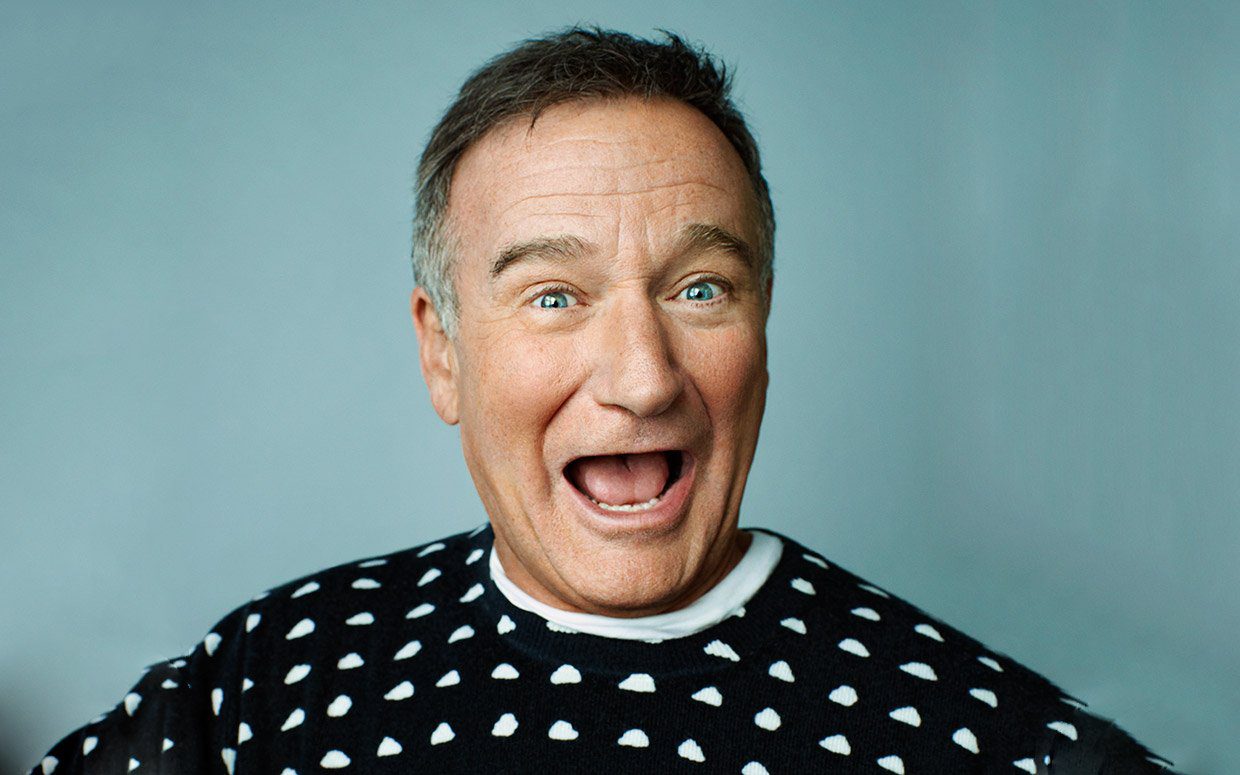
The outpouring of grief following Robin Williams death was unlike almost anything seen before in modern celebrity culture. Tributes poured in from every corner of the entertainment world. Presidents spoke about him. Strangers gathered outside his star on the Hollywood Walk of Fame. Social media was filled with clips from his most iconic roles — Mrs. Doubtfire, Good Will Hunting, Dead Poets Society, Aladdin, Good Morning Vietnam. People were not just mourning a comedian or an actor. They were mourning someone who felt like family.
His co-stars and collaborators shared deeply personal memories. Matt Damon and Ben Affleck, who had worked with him on Good Will Hunting, spoke movingly about his generosity and warmth. His friends from the comedy world described a man who was endlessly giving, always trying to make everyone else laugh even when he himself was struggling. This image of Robin Williams — generous, compassionate, constantly performing for others — made Robin Williams death feel even more poignant. He had spent his entire life trying to ease other people’s pain, and yet his own pain had gone largely unseen.
The memorials and tributes that followed Robin Williams death were not just about celebrating what he had done. They were also a collective reckoning with how little we sometimes understand about the inner lives of the people who bring us the most joy. His death forced both the public and the entertainment industry to ask harder questions about how we treat performers, how we recognize suffering in high-functioning individuals, and what we owe each other in terms of genuine care and attention.
The Legacy Robin Williams Left Behind
Years after Robin Williams death, his legacy continues to grow rather than fade. His films are still watched by new generations discovering them for the first time. His stand-up specials still make people laugh until they cry. His dramatic performances — particularly in Good Will Hunting, for which he won an Academy Award — are still taught in film schools and studied by aspiring actors around the world.
But perhaps the most enduring part of his legacy is the human one. Robin Williams death changed the way many people talk about mental health and brain disease. It reminded the world that suffering does not always look the way we expect it to. It taught us that the funniest person in the room can also be carrying the heaviest burden. These are lessons that extend far beyond Hollywood or entertainment — they apply to everyday life, to the people we work with, live with, and love.
Susan Schneider Williams continues to honor his memory through advocacy and education around Lewy body dementia. The Robin Williams Foundation and various associated charities carry on work that reflects his values — compassion, creativity, and a commitment to helping those who are struggling. His children have spoken publicly about their father with tremendous grace and love, keeping his spirit alive in a way that feels authentic and true to who he was.
Robin Williams death was a tragedy in every sense of the word. But the conversations it started, the awareness it raised, and the love it unleashed remind us that even in the darkest moments, there is something worth holding onto. His life was a gift. His memory is a responsibility one that millions of people around the world take seriously every single day.
You May Also Read