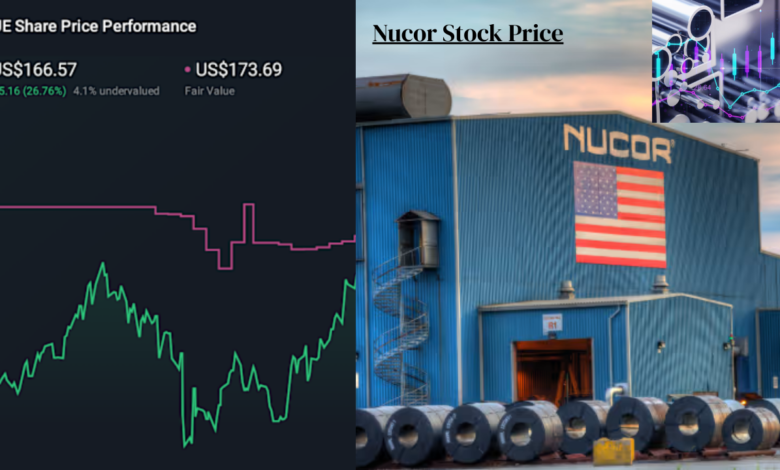
Nucor Stock Price if you’ve been paying attention to the steel sector lately, chances are Nucor has crossed your radar more than once. It’s one of those companies that doesn’t always grab the flashiest headlines, but when you dig into the numbers and the business model, it becomes very clear why serious investors keep coming back to it. Whether you’re a seasoned market participant or someone just starting to build a portfolio, understanding Nucor Stock Price where it’s been, what drives it, and where it might be headed is genuinely worth your time.
This article breaks down everything you need to know about Nucor stock in a way that’s straightforward, grounded in reality, and actually useful.
Who Is Nucor and Why Does It Matter to Investors
Nucor Corporation is the largest steel producer in the United States by volume, and that alone should tell you something. Founded in 1940 and headquartered in Charlotte, North Carolina, Nucor has spent decades building a reputation not just for producing steel, but for doing it smarter than most of its competitors. The company operates a network of steel mills, steel products facilities, and raw materials operations across the country.
What makes Nucor Stock Price particularly interesting from an investment standpoint is its business model. Unlike traditional integrated steel mills that rely heavily on blast furnaces and iron ore, Nucor primarily uses electric arc furnaces (EAF) and scrap metal. This makes its production process significantly more flexible and cost-efficient. When steel prices drop, Nucor can scale back operations without the catastrophic fixed-cost burden that typically crushes other producers in a downturn. That operational agility has a direct and meaningful impact on its earnings — and by extension, on its stock price.
Nucor is also a member of the S&P 500 and has long been a staple in industrials-focused ETFs and dividend-growth portfolios. The company has increased its dividend for over 50 consecutive years, earning it the prestigious Dividend King status a distinction very few companies ever achieve. For income-focused investors, that track record is practically impossible to overlook.
Historical Performance of Nucor Stock Price

To really understand where Nucor Stock Price stands today, it helps to look back at how it has moved over time. Nucor Stock Price has gone through several clear cycles that closely mirror the broader steel market, commodity price fluctuations, and macroeconomic conditions which is exactly what you’d expect from a company in the materials sector.
In the years following the 2008 financial crisis, Nucor Stock Price was relatively subdued along with the broader steel industry. Weak demand, global overcapacity (largely driven by Chinese steel production), and sluggish infrastructure spending kept a lid on steel prices for much of the 2010s. Nucor’s stock reflected that environment, trading in a range that disappointed many growth-oriented investors even as the broader market surged.
The real inflection point came around 2020 and 2021. As pandemic-related supply chain disruptions collided with a surge in construction activity, infrastructure spending, and manufacturing demand, steel prices shot up dramatically. Nucor Stock Price followed suit, delivering extraordinary returns to shareholders in a very compressed timeframe. The company posted record earnings during this period, which fueled further confidence in the stock. From its pandemic lows to its subsequent highs, Nucor Stock Price performance was nothing short of remarkable, significantly outpacing many better-known names in the broader market.
Key Factors That Drive Nucor Stock Price
Understanding what moves Nucor Stock Price is fundamental to making sense of any investment decision involving the company. Unlike a tech company where sentiment and future earnings projections do most of the heavy lifting, Nucor’s valuation is deeply tied to real-world economic dynamics.
Steel prices are probably the single biggest short-term driver of Nucor Stock Price. When hot-rolled coil prices rise, Nucor’s margins expand quickly because its variable cost structure allows it to capture that upside almost immediately. Conversely, when steel prices decline as they inevitably do in cyclical downturns margins compress and earnings fall, which typically pushes the stock lower. Investors who fail to appreciate this cyclicality often get burned buying Nucor at the peak of a cycle when earnings look spectacular but are actually unsustainable at those levels.
Infrastructure spending is another major catalyst. Government investment in roads, bridges, pipelines, and industrial facilities drives demand for structural steel products, which is a significant part of Nucor’s business. Policy decisions around domestic manufacturing and trade particularly tariffs on imported steel also play a major role. Tariffs that protect domestic steel producers from cheaper foreign competition tend to support higher steel prices in the U.S. market, which benefits Nucor’s bottom line and typically gives the stock a lift.
Beyond those macroeconomic factors, Nucor Stock Price own strategic initiatives matter. The company has been aggressively expanding its product mix, moving into higher-value steel products and downstream fabrication. These moves help reduce Nucor’s dependence on the most commoditized end of the steel market and can support stronger, more stable margins over time which is exactly what long-term investors want to see.
Nucor’s Dividend History and What It Means for the Stock
One of the most compelling aspects of Nucor’s story is its dividend track record. The company has raised its dividend every single year for more than five decades, placing it in the elite category of Dividend Kings companies with at least 50 consecutive years of dividend increases. This is not a trivial achievement. Maintaining that kind of consistency through recessions, commodity crashes, and global financial crises requires genuine financial discipline and a management team deeply committed to rewarding shareholders.
For investors focused on total return, the dividend matters in a couple of ways. First, it provides a real income stream that cushions the blow during periods when the stock price is under pressure. If Nucor Stock Price pulls back during a steel downturn, you’re still collecting that dividend and if you’re reinvesting it, you’re accumulating more shares at lower prices. Second, the dividend growth rate signals management’s confidence in the business. A company that keeps raising its dividend year after year is telling the market that it expects to keep generating strong free cash flow, even through tough periods.
Nucor also supplements its base dividend with variable supplemental dividends when earnings are particularly strong. This structure is smart it lets the company share the windfall during boom times without overcommitting to a dividend level that would be unsustainable during a trough. It’s the kind of thoughtful capital allocation that makes Nucor stand out from peers that have historically mismanaged their balance sheets during good times and paid the price when conditions deteriorated.
How to Evaluate Nucor Stock Price Relative to Value
Valuing a cyclical company like Nucor is genuinely tricky, and this is where a lot of retail investors make mistakes. If you just look at Nucor’s price-to-earnings (P/E) ratio at the top of a steel cycle, it will often look misleadingly cheap because earnings are at a temporary peak. Conversely, at the bottom of a cycle, the P/E ratio might look terrifyingly high or even negative because earnings have collapsed, even as the stock may actually be near an attractive entry point.
Experienced investors typically use normalized earnings or mid-cycle earnings estimates when evaluating Nucor Stock Price. This approach strips out the noise of cyclical peaks and troughs and gives you a better sense of what the business is really worth over a full economic cycle. Other useful metrics include price-to-book value, enterprise value to EBITDA, and free cash flow yield all of which give you different lenses through which to assess whether the current stock price represents a fair deal, a bargain, or an overvalued situation.
It’s also worth comparing Nucor’s valuation to its closest peers in the domestic steel industry. Companies like Steel Dynamics and Cleveland-Cliffs operate in the same general space, and tracking how the market values each of them relative to their earnings and asset base can reveal useful insights. When Nucor trades at a significant premium to peers, that premium is typically justified by its superior management track record, stronger balance sheet, and more consistent profitability but there’s always a point where even a premium stock becomes too expensive relative to realistic future returns.
Risks Every Investor Should Understand
No serious discussion of Nucor Stock Price would be complete without an honest conversation about the risks. The steel industry is cyclical by nature, and that means Nucor’s earnings and stock price can be quite volatile. Investors who bought at the wrong point in the cycle have experienced painful drawdowns, even in a company as well-managed as Nucor.
Global steel overcapacity remains a persistent structural issue. China, in particular, continues to produce far more steel than its domestic economy needs, and the excess supply has a tendency to find its way into global markets, pressuring prices. While U.S. tariffs have provided some protection, trade policy is inherently unpredictable and can shift in ways that significantly affect Nucor’s competitive position.
Raw material costs particularly the price of scrap metal are another variable that directly affects margins. When scrap prices rise faster than finished steel prices, the spread narrows and profitability suffers. Energy costs, particularly electricity for electric arc furnace operations, are also a meaningful input cost that can fluctuate significantly.
Finally, a broader economic slowdown or recession would typically hurt Nucor Stock Price, as construction activity and industrial demand tend to fall sharply when the economy contracts. Investors need to be comfortable with that kind of cyclical volatility and have a realistic time horizon before committing capital to the stock.
Final Thoughts Is Nucor Stock Worth Watching
Nucor Stock Price is one of those companies that rewards patient, informed investors and punishes those who chase momentum without understanding the underlying business. The stock has delivered exceptional long-term returns, driven by disciplined management, a unique cost-efficient business model, and an impressive track record of returning cash to shareholders. The Dividend King status alone makes it worth keeping on your watchlist if you care at all about income investing.
That said, timing matters with a cyclical stock like Nucor. Buying when steel prices are depressed and sentiment is negative even though it feels uncomfortable has historically been the path to the best returns. Buying at the top of a cycle, when earnings are record-high and analysts are euphoric, has typically led to disappointment.
If you’re evaluating Nucor Stock Price right now, the key questions to ask are: Where are we in the steel cycle? What is the normalized earnings power of the business? And does the current price give you an adequate margin of safety relative to that normalized earnings power? Answer those questions honestly, and you’ll be in a much better position to make a smart decision about whether Nucor deserves a place in your portfolio.
You May Also Read