
Revenue vs Profit If you’ve ever looked at a company’s financials and thought, Wait, they made millions but still went broke? you’re not alone. The confusion between revenue vs profit trips up entrepreneurs, students, and even seasoned business folks more often than you’d think. These two numbers tell very different stories, and mixing them up can lead to some seriously bad decisions. So let’s break it all down in plain language, without the boring finance textbook energy.
Understanding Revenue The Top Line
Revenue is the total amount of money a business brings in from selling its products or services before anything gets taken out. It’s often called the “top line” because it literally sits at the top of an income statement. Think of it as the gross haul your business pulls in before the bills start piling up.
Now, revenue sounds exciting. A company reporting $10 million in revenue sounds like a massive success, right? Not necessarily. Revenue only tells you how much came in the door. It says nothing about how much it cost to keep that door open. A business can have jaw-dropping revenue and still be bleeding money every single month.
There are different types of revenue worth knowing about. Operating revenue comes from the core business activities a shoe company selling shoes, for example. Non-operating revenue comes from side activities like investments, asset sales, or licensing deals. Both count toward the total, but understanding where revenue is coming from matters a lot when you’re evaluating business health.
Understanding Profit The Bottom Line
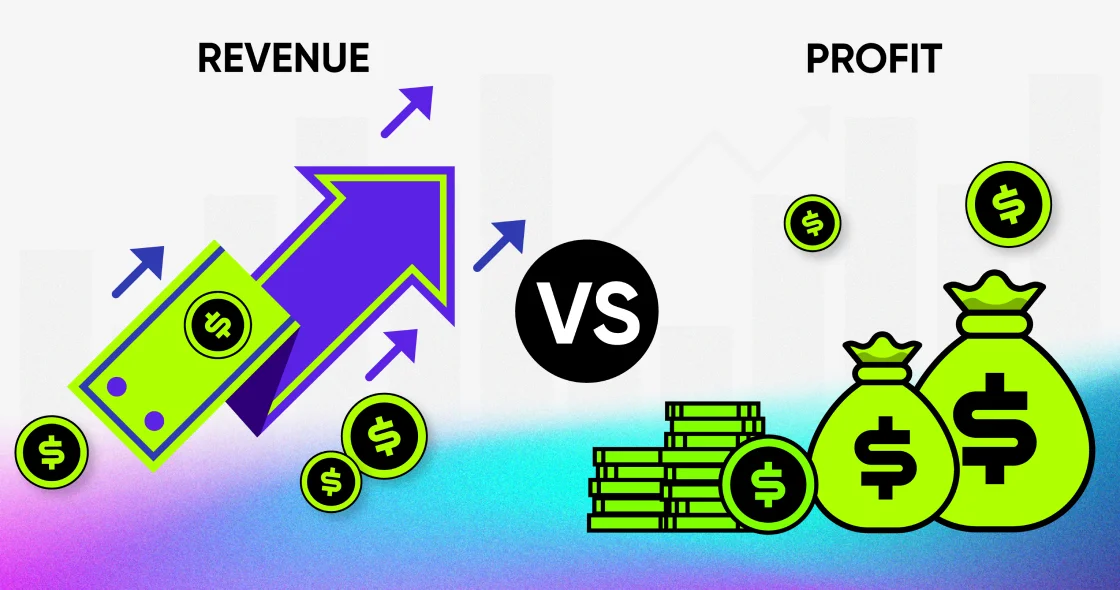
Revenue vs Profit is what’s left over after you subtract all the costs from your revenue. It’s the bottom line the number that tells you whether a business is actually making money or just moving money around. And yes, there’s a big, important difference between the two.
Profit comes in a few flavors. Gross profit is revenue minus the direct cost of producing goods or services (called cost of goods sold or COGS). Operating profit takes it a step further by also subtracting operating expenses like rent, salaries, and utilities. Net profit — the one everyone really cares about — is what’s left after taxes, interest, depreciation, and every other expense has been deducted. Net profit is the truest measure of financial success.
Here’s where it gets real: a company can have growing revenue and shrinking profit at the same time. If you’re spending $9 million to generate $10 million in revenue, your net profit is only $1 million. Scale up without controlling costs? That margin can disappear fast. The revenue vs profit conversation is really about efficiency, sustainability, and whether a business model actually works in the real world.
Revenue vs Profit The Core Difference
Let’s get straight to the heart of it. Revenue is what you earn. Profit is what you keep. That one sentence sums up the entire revenue vs profit debate, but the implications run deep.
Imagine two food truck businesses. Truck A makes $500,000 a year in revenue. Truck B makes $200,000. On the surface, Truck A looks like the winner. But if Truck A spends $480,000 on ingredients, staff, fuel, parking permits, and maintenance, its profit is only $20,000. Truck B, running lean with smart sourcing and low overhead, spends $120,000 and walks away with $80,000 in profit. Suddenly, Truck B is the smarter business. That’s exactly why comparing revenue vs profit tells a much fuller story than looking at either number alone.
Investors, lenders, and business partners all understand this distinction intuitively. A business pitching huge revenue numbers without solid profit margins raises red flags. It suggests the business may be scaling too fast, pricing poorly, or operating inefficiently. On the flip side, a small but highly profitable business is often more attractive than a large, revenue-heavy operation that barely breaks even.
Why Businesses Focus on Revenue First
Here’s something that surprises a lot of people: many successful businesses — especially startups — deliberately prioritize revenue growth over profit in their early stages. This isn’t reckless. It’s actually a calculated strategy, and understanding it is key to the revenue vs profit discussion.
The logic goes like this to capture market share quickly, you sometimes need to spend aggressively. You invest in marketing, hire fast, undercut competitors on pricing, and grow your customer base before tightening up operations. Amazon famously operated at a loss for years while building its empire. The bet was that massive revenue and market dominance would eventually translate into serious profit — and it did.
Revenue vs Profit This approach works when there’s strong investor backing, a clear path to profitability, and a market worth dominating. But it’s dangerous when copied without those conditions. Small business owners who pour everything into chasing revenue without a profit plan often end up with impressive numbers on paper and empty bank accounts in reality. Knowing when to chase revenue and when to protect profit is one of the most important skills in business.
Profit Margins Where Revenue vs Profit Gets Practical
Once you understand the difference between Revenue vs Profit, the next step is learning how to measure the gap between them and that’s where profit margins come in. A profit margin is simply profit expressed as a percentage of revenue. It tells you how efficiently a business converts sales into actual earnings.
A 5% net profit margin means for every $100 in revenue, the business keeps $5. A 30% margin means it keeps $30. Higher margins generally mean a healthier, more sustainable business. Industries vary a lot here — grocery stores often run on razor-thin margins of 1–3%, while software companies can hit margins of 20–30% or more. Knowing your industry’s average helps you benchmark realistically.
Tracking profit margins over time is one of the most powerful habits a business owner can develop. If revenue is growing but margins are shrinking, something’s off — maybe costs are rising faster than prices, maybe there’s operational waste, or maybe a pricing strategy needs revisiting. The revenue vs profit relationship, when viewed through the lens of margins, becomes an early warning system for business problems before they spiral.
Common Mistakes People Make Confusing Revenue and Profit
One of the most costly mistakes in business — especially among new entrepreneurs — is celebrating revenue like it’s profit. You close a $100,000 contract and feel like a millionaire. But once you pay subcontractors, cover overhead, and account for taxes, maybe $15,000 actually stays with you. Treating the full contract value as a win before understanding the true cost structure is a recipe for financial stress.
Another common mistake is using revenue as the primary pitch metric without context. “We did $2 million in revenue last year” sounds great in conversation, but sophisticated investors will immediately ask about margins. If those margins are terrible, the revenue figure becomes less impressive fast. The revenue vs profit gap is one of the first things an experienced investor scrutinizes during due diligence.
Businesses also sometimes cut prices to boost revenue without thinking through the impact on profit. Selling more at lower prices can actually hurt you if the margin per unit shrinks significantly. Volume doesn’t save you if you’re losing money on each sale. That’s a trap plenty of businesses fall into, and it’s exactly why keeping revenue vs profit clearly separated in your financial thinking is non-negotiable.
How to Improve Both Revenue and Profit
The good news is that Revenue vs Profit aren’t always in conflict. With the right strategies, you can grow both simultaneously and that’s the real goal of any sustainable business.
To grow revenue, focus on expanding your customer base, increasing the average transaction value, improving your marketing reach, and launching new products or services. Upselling and cross-selling to existing customers is often the fastest and cheapest way to push revenue higher, since you’re not spending on customer acquisition.
To improve profit, look at your cost structure hard and honestly. Are there operational inefficiencies? Vendor contracts that need renegotiation? Subscriptions or tools you’re paying for but barely using? Small cost reductions across multiple areas compound quickly. Pricing strategy also plays a massive role — many businesses are simply undercharging, leaving significant profit on the table without even realizing it. When you optimize both sides of the revenue vs profit equation, the results can be transformative.
Final Thoughts
At the end of the day, revenue vs profit is one of the most fundamental concepts in business finance — and it’s one that deserves serious attention from anyone running, investing in, or analyzing a business. Revenue tells you how big the engine is. Profit tells you how well it runs.
Neither number exists in a vacuum. A business with strong revenue but weak profit needs to examine its cost structure and pricing. A business with strong profit but stagnant revenue may be missing growth opportunities. The healthiest businesses track both obsessively, understand the relationship between them, and make strategic decisions that move both numbers in the right direction.
Whether you’re an entrepreneur just starting out, a manager trying to make sense of your company’s financials, or an investor evaluating an opportunity — get comfortable with revenue vs profit. Master this distinction, and you’ll have a sharper, more grounded understanding of how businesses actually work.
You May Also Read